

The Best Food in Sri Lanka: 15 Things You Need to Try

When I first visited Sri Lanka I knew nothing about Sri Lankan cuisine.
(ignorant – huh!)
3 weeks, 2 cooking classes, and a LOT of eating out later I had fallen in love with the subtle complexity of this country’s cooking.
Now I’m always on the lookout for Sri Lankan restaurants wherever I go (which proves a little hard down here in New Zealand / Australia)
But enough about me – in this article I’m going to share the must-try foods you’ll experience when you go to Sri Lanka. From hoppers and eight-dish curries, to roti kottu, to the boozy arrack.
I’ve also included as many photos as possible (because yes, I’m the sort of person to take photos of every meal I eat while traveling!)
Sri Lankan food is built around rice, coconut, chilli, curry leaves, pandan, lime and a spice cupboard that has clearly been allowed to get out of hand. But the good bit is how those flavours arrive together. You do not order one brown curry in one brown bowl. You get colour, crunch, heat, acid and about six things you cannot identify but immediately want more of.
These are the 15 foods and drinks I would actively look for. Not every ingredient with a Wikipedia page. The actual things I would want another traveller to try.
Table of Contents
What Eating in Sri Lanka Actually Looks Like
Breakfast can be hoppers, string hoppers, dhal, sambol and curry rather than cereal trying to convince you it counts as a meal. Lunch is prime rice-and-curry territory: trays of dishes laid out behind glass, a mountain of rice, then whichever combination takes your fancy. Dinner is when the kottu griddles start making that unmistakable clack-clack-clack down the street.
Meals do not need to be expensive or elaborate. Some of the best are at tiny, busy places where the choices are whatever was cooked that day. Pointing works. So does asking for a little of everything, although this can result in a plate with its own weather system.
Vegetarians are particularly well looked after. Dhal, pumpkin, beans, beetroot, okra, eggplant, jackfruit and leafy mallung are proper parts of the meal, not side dishes included because the chef found out you were coming. Just ask whether Maldive fish has been used in the sambol or vegetable dishes if you avoid fish completely.
1. Rice and Curry

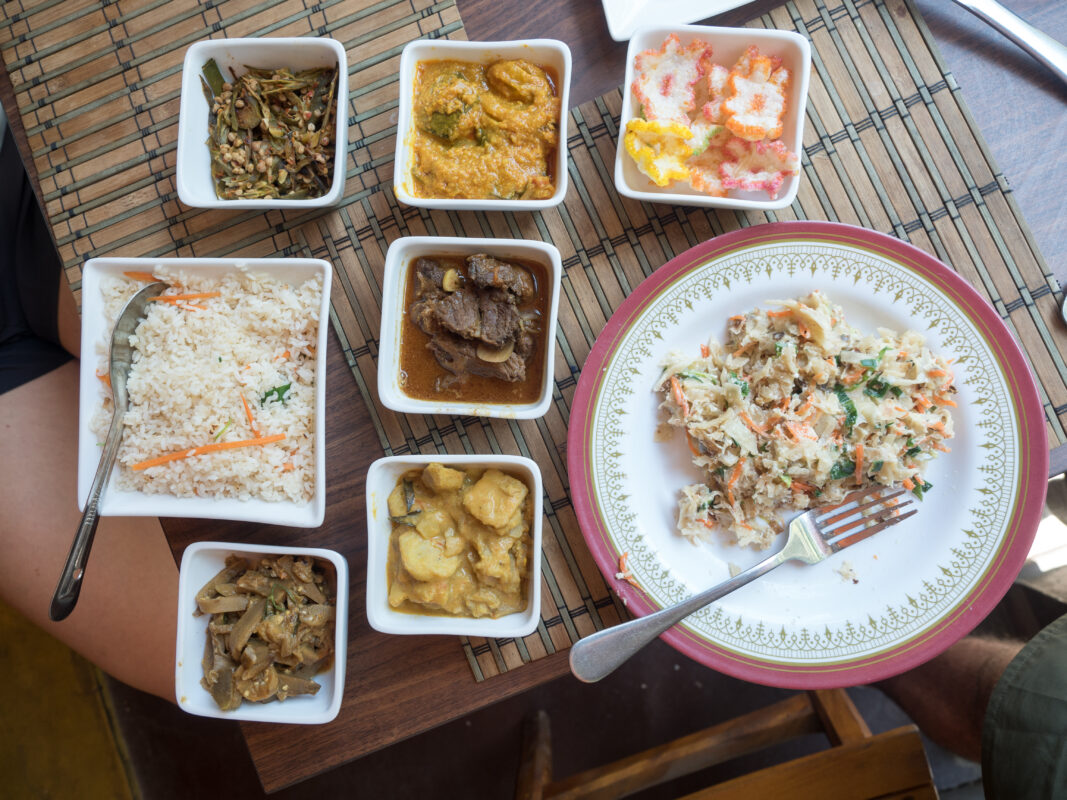
Rice and curry sounds like one dish. In Sri Lanka, it can mean a plate of rice with eight different curries arranged around it, which is obviously much better.
My first one arrived with about ten separate dishes and I was blown away. Pumpkin curry, beans, dhal, something sharp and pickled, something green, something properly spicy, sambol, meat or fish… you pick and mix everything onto the rice and somehow every mouthful tastes different.
That generosity is what I remember most. You ask for curry and receive a tiny buffet. Start gently if you are unsure about the chilli, but do not mix the whole plate into one beige mound immediately. Try the curries separately first, then begin engineering your ideal forkful.


2. Hoppers

I loved the hoppers. They are bowl-shaped pancakes made from fermented rice flour and coconut milk, thin and crisp around the edges but soft in the middle. An egg hopper has an egg cooked straight into that centre, ready for sambol and curry.
They are one of those foods that make complete sense as soon as you eat one. Crisp, soft, spicy, slightly sour. Breakfast sorted.
3. Kottu Roti

At night you will hear kottu before you see it: metal blades hammering chopped roti across a hot griddle, mixed with vegetables, egg, curry, chicken and, if you have made the correct decision, cheese.
The best souvenir you can bring home from Sri Lanka is knowing how to make the food. Shop a local market, then cook a spread of curries with a local family. Hands-on, and unforgettable.
See the Sri Lankan cooking class →The chicken and cheese kottu was the perfect deconstructed kebab. Greasy, spicy, cheesy, chopped into a glorious mess and exactly what you want after a long day. Turks – take note.
The cheese kottu in the photo was the first one I tried and still my favourite. It is not delicate food. It does not need to be.
4. String Hoppers

String hoppers are nests of steamed rice noodles, usually eaten at breakfast or dinner with dhal, curry and sambol. They look intricate, but the basic process is oddly satisfying: press the dough into fine noodles, spiral them onto little mats, then steam.
I made these during one of my cooking classes and achieved something that was technically recognisable as a string hopper. The locals were faster. Much faster.
5. Pol Sambol

Pol sambol is the small side dish that wakes up almost everything beside it. Fresh coconut is mixed with chilli, onion, lime and usually Maldive fish, giving it heat, freshness and a little salty funk.
Spoon it into hoppers, eat it with roti, or drag it through a plate of rice and curry. You will see it constantly, and that is good news.
6. Parippu Dhal

Parippu is Sri Lankan lentil curry, usually cooked with coconut milk, turmeric, curry leaves and spices. It is mild, creamy and appears with everything from breakfast string hoppers to a full rice-and-curry lunch.
It is also the dish that rescues you when your confidence with chilli has exceeded your actual ability. Mix it through the rice, regain feeling in your face, continue.
7. Fish Ambul Thiyal

Fish ambul thiyal is a dry, dark and sharply sour fish curry from southern Sri Lanka. The sourness comes from goraka, and the fish is cooked down with pepper and spices until the sauce clings to it rather than pooling around it.
It is punchier than the coconut-heavy curries you may expect, and brilliant with plain rice. Look for it around the south coast, particularly in homestyle restaurants and guesthouses.
8. Polos: Young Jackfruit Curry

Young jackfruit is cooked slowly with coconut milk and spices until it becomes rich, soft and almost meaty. This is polos, and it is one of the best examples of why a vegetarian meal in Sri Lanka never feels like the consolation option.
It commonly appears as one part of a rice-and-curry spread. Take more than the polite first spoonful.
9. Wambatu Moju

Wambatu moju is fried eggplant tossed with vinegar, chilli, onion, sugar and spices. It sits somewhere between pickle, relish and curry, with a sweet-sour edge that cuts through a heavier plate.
Even people who claim not to like eggplant tend to mysteriously finish it. Draw your own conclusions.
10. Lamprais

Lamprais is a Dutch Burgher dish of rice, meat curry, sambol and accompaniments wrapped in banana leaf and baked together. It is compact, fragrant and much more substantial than the parcel first appears.
A proper lamprais takes work, so seek it out somewhere known for making it rather than assuming every banana-leaf rice parcel is the same thing. Colombo is your best hunting ground.
11. Short Eats

Short eats are Sri Lanka’s cabinet snacks: vegetable roti, fish buns, patties, rolls, cutlets and other fried or baked bits designed to fill the gap between meals. Bakeries and little cafes stack them behind glass, usually with minimal explanation.
Point at whatever looks good, order tea, and accept that you may only identify the filling once you bite into it. That is half the fun.
12. Kiribath

Kiribath is rice cooked with coconut milk, pressed into a slab and cut into diamonds. It is especially associated with celebrations and auspicious beginnings, but you will also find it at breakfast, usually with a fierce onion-and-chilli sambol called lunu miris.
The milk rice itself is gentle. The sambol is not. Use the former to negotiate with the latter.
13. Watalappan

Watalappan is a steamed coconut custard flavoured with jaggery, cardamom and nutmeg, with roots in Sri Lanka’s Malay community. Think creme caramel, but darker, spicier and more interesting.
After days of chilli and curry, a cold wobbling slice is an extremely sensible way to finish dinner.
14. Ceylon Tea

Tea is not exactly a dish, but going to Sri Lanka and ignoring Ceylon tea would be a fairly committed bit of nonsense. Visit an estate in the hill country, taste several grades side by side, and you quickly realise how much variation hides behind the word tea.
The hill-country setting is half the experience, but the tasting itself is worth doing properly. The pale, delicate high-grown teas can taste completely different from the stronger stuff you have probably been attacking with milk your entire life.
15. Coconut Arrack

At the other end of the day, try arrack: Sri Lanka’s local spirit distilled from fermented coconut-flower sap. It sits somewhere around the rum-whisky neighbourhood, depending on the bottle, and you will see it behind bars and in bottle shops all over the island.
Drink it neat, with soda or water, with ginger beer, or in a cocktail. Some bottles are smooth and interesting. Some taste like consequences. Ask what you are being poured.
How to Find the Good Stuff
The best meals were not always attached to the smartest dining rooms. In Sri Lanka, a local restaurant may call itself a hotel even though there is not a bed anywhere in sight. A busy hotel at lunchtime, with curries laid out behind glass and locals moving through quickly, is usually a much better sign than a laminated menu containing pizza, noodles, burgers and emotional distress.
Guesthouses are another easy win. Ask what dinner costs, say yes, and you may get a better spread than anything nearby. For hoppers, look in the morning or evening. For fresh kottu, follow the metallic chopping noise after dark.
Tip: Take a cooking class early in the trip. I did two, and they made every meal afterwards more interesting because I finally knew what the leaves, spices and little bowls were doing. Choose a class that includes a market visit or a genuinely hands-on meal, not one where you watch somebody else cook while holding a wooden spoon for the photo.
How Spicy Is Sri Lankan Food?
It can be properly hot, but a rice-and-curry spread gives you some control. Dhal, coconut sambol and milder vegetable curries can soften the fiercer dishes, and you can build each mouthful rather than committing the entire plate at once.
If somebody asks whether you want it spicy, remember they may be calibrating against Sri Lankan taste buds rather than yours. I support optimism in most areas of travel. Chilli is where a little humility pays off.
What I Would Eat Again First
I would start with egg hoppers, order rice and curry whenever I saw a busy lunch spread, and save the chicken and cheese kottu for a night when dignity had already left the building.
But the best part of Sri Lankan food is not really one winning dish. It is ordering one curry and watching eight curries arrive. It is the sambol that changes the whole plate, the hopper edge that shatters when you fold it, and the complete certainty that you should have taken a bigger spoonful of the jackfruit.
Go hungry. Sri Lanka will handle the rest.
Sri Lanka Travel Planning Cheatsheet
🚑 Should I buy travel insurance for Sri Lanka?
100% YES! — Sri Lanka has free healthcare and it works pretty well, but it’s something you don’t want to experience if you’re in an emergency. For the private hospitals you’ll need travel insurance in case anything happens on your visit. Also be aware many policies won’t cover adventure activities like motorbike riding, diving as they are deemed ‘high risk’.
(that’s right, check the t&c’s on your complimentary credit card insurance)
I highly recommend World Nomads as you can get specific add-ons for all the activities you’ve got planned
🎫 Do I need a visa for Sri Lanka?
Yes. All tourists entering Sri Lanka now require an Electronic Travel Authorisation (ETA). You can apply for it here.
💉Do I need any vaccinations for Sri Lanka?
YES! Make sure you are up-to-date with all your vaccines. Common travel vaccines include Hep A/B + Typhoid, and Diphtheria + Tetanus.
Rabies is also an issue in Sri Lanka but the vaccine is expensive and ineffective as a preventative measure (it only lasts a few years and you’ll need to get them again if you require treatment). If bitten by a stray dog (like I was!) seek immediate medical attention!
As always, talk to your GP or specialised travel doctor a few weeks BEFORE you leave.
💸How do you pay for things in Sri Lanka?
Cash is king in Sri Lanka, so you’ll want to get some folding tender out from an ATM when you land. Larger businesses and hotels will take Debit / Credit Card but most resturants, and street vendors want cash.
I personally use (and love!) my Wise travel debit card for all my international money needs as they only convert the funds when you make payment, plus they offer a much better spread (margin on the true exchange rate) than the banks do. They work in all the Sri Lankan ATMs I tried. .
→ Get the Wise card I use — set it up before you fly so it’s ready to tap the moment you land.
📲 How do I get internet/data/wifi in Sri Lanka?
This one needs a whole nother article, but the short version is prepaid SIM cards are cheap and availible to tourists and locals alike (You don’t need a pricey tourst SIM!)
Your cheapest option is buying a physical sim card on the street corner once landed and getting the shop assistant to help you set it up. I went with Vodafone and had generally good coverage.
Now when I travel I’m a bit lazy and prefer to use an Airalo eSIM. This is a little more expensive but works from the moment you land is is SOOOOO much easier than the in person verification process required for a local sim. I’ve used Airalo all over the world and it has never let me down
✈️ What’s the best site to buy flights to Sri Lanka?
For finding cheap flights, I recommend Skyscanner or Google Flights. Once you find the flight you’re looking for, I’d then suggest booking directly with the carrier (even if it costs a few $$ more than with one of the agreggators/agencies).
💧Can you drink the water in Sri Lanka?
Safest not to — tap water in Sri Lankain some areas (Colombo and Kandy etc) may be OK (I drank it without any issues) but is generally untreated and not reccommended for tourists. Purchase bottled water for drinking and teeth brushing.


