

The 11 Best things to do in Te Tai Tokerau, Northland | On a Road Trip

Te Tai Tokerau / Northland is one of those places that combines wild beauty, fascinating history and a sense of endless adventure.
It’s probably my favourite part of New Zealand, and I’ve managed to venture up here almost every summer over the last 10 years.
Here are the 11 best things (I reckon) to do on a Northland road trip. There are bigger lists online, but these are the places I would actually build the drive around.
Table of Contents
1. Stretch Your Legs on the Cape Brett Lighthouse Hike
If you’ve got two spare days and itchy feet, the overnight hike to Cape Brett Hut is one of Northland’s great adventures. The full track is 16.3 km each way, although a water taxi to Deep Water Cove trims the walking to roughly 6 km each way. Very fit walkers also tackle the full route as one enormous day.


The undulating trail teases you with glimpses of rugged cliffs and islands before eventually spitting you out beside the decommissioned lighthouse, right on the edge of the peninsula.
The DOC hut is the old lighthouse keeper’s quarters. I have stayed there both before and after its 2024 renovation, and the improved water system, toilets and fresh lick of paint have made a real difference.
The distance did not look outrageous on paper, but I badly underestimated how punishing the track would be. We climbed roughly 1,300 metres each day. The treats were worth the mahi, though: we woke to one of the best sunrises I’ve seen in New Zealand.
The full track starts behind Oke Bay Lodge in Rāwhiti, around 30 km beyond Russell. Sort your parking before you arrive and do not assume access beside the lodge is free; the dedicated guide below explains the slightly messy local setup.
The public section from Deep Water Cove to Cape Brett is free. Walking the full route across private land currently requires a walkway permit costing NZ$50 per adult or NZ$20 per child or youth, on top of the separate DOC hut booking.
I’ve got a more comprehensive guide to the Cape Brett lighthouse walk here.
2. Snorkel the Goat Island Marine Reserve

Goat Island was New Zealand’s first marine reserve, and it remains one of the easiest places in the country to get properly close to fish. The water is reasonably shallow and sheltered, so you do not need to venture far from shore or be Jacques Cousteau to have a good time.
Take your own snorkel or hire the full setup from Goat Island Dive & Snorkel. We did their guided scuba trip one summer and it was awesome, but the beauty of Goat Island is that the basic shore snorkel is already brilliant.
It is about an hour north of Auckland, through Matakana and Leigh. The reserve car park sits above the beach; from there it is a short downhill walk, which feels considerably longer when you are carrying wet gear back up.
3. Brush Up on New Zealand History at the Waitangi Treaty Grounds

Waitangi is often described as the nation’s birthplace. He Whakaputanga, the Declaration of Independence, was signed here in 1835, followed by Te Tiriti o Waitangi and the Treaty of Waitangi in 1840.
The museums and grounds do a very good job of explaining what was signed, by whom, and why the two texts still sit at the centre of life in Aotearoa. Admission also includes a 50-minute guided tour and a Māori cultural experience, rather than just leaving you to wander around reading plaques.
For international visitors, it is an excellent introduction to New Zealand history. But as a local, I also believe Waitangi is somewhere every Kiwi needs to visit at least once.
The grounds are a five-minute drive or roughly 25-minute walk from central Paihia. Current admission is NZ$37 for New Zealand adults and NZ$74 for international adults, valid for two consecutive days; children aged 12 and under enter free with a paying adult.
You can book ahead and check the current programme on the official Waitangi website. Give it at least half a day. This is not the stop to squeeze between a petrol station pie and the next beach.
4. Take in the Sunset at Baylys Beach

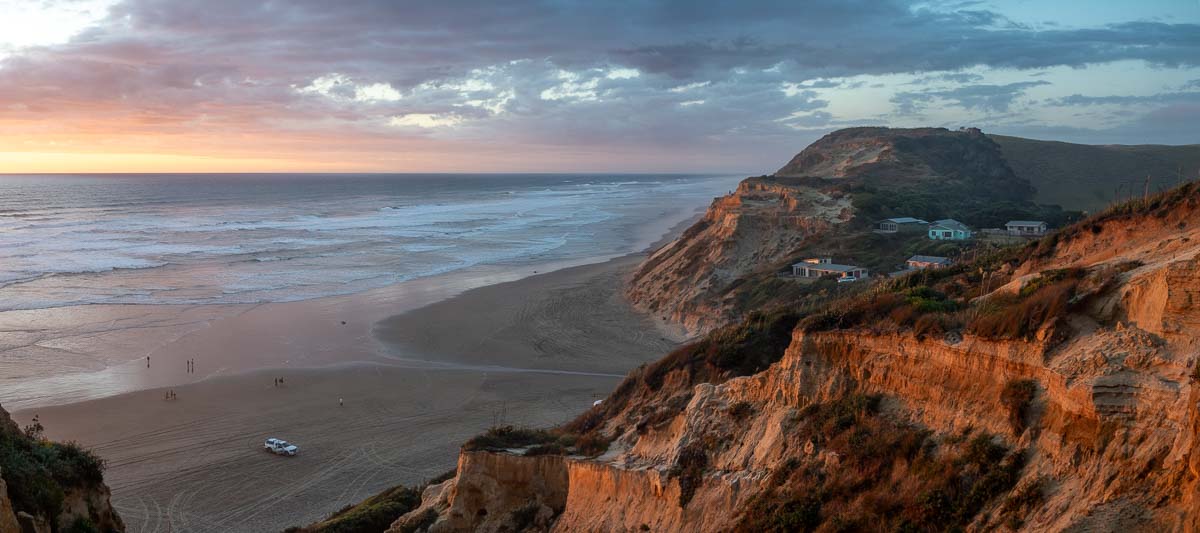


Baylys Beach is a long sweep of grey sand on Northland’s west coast, about 10 minutes from Dargaville. It is not polished or tropical. That is exactly why I like it.
Unlike the east-coast beaches, Baylys feels wild, barren and almost completely untouched. You can walk for tens of kilometres and see very little except cliffs, surf and the occasional vehicle – the beach is technically a road, because Northland.
My favourite memory here is sitting out on the rocks as the sun went down over the water. The short clifftop walk above the beach gives you the same huge west-coast view without needing to commit quite so hard to the incoming tide.
There is plenty of parking at the beach entrance. Baylys Beach Holiday Park is a five-minute walk from the sand, while Sharky’s Bar and Fish & Chips covers dinner if you stay for sunset. The beach itself is free.
Bring a layer. The west coast can go from golden and lovely to properly chilly the moment the sun drops.
5. Take a Dip at Oke Bay

Oke Bay is the easy swimming stop I would pair with Cape Brett. It is tucked into the Bay of Islands, with clear, calm water and enough separation from the road to keep the casual drive-by crowds away. I spent hours here lounging on the beach and dipping in and out of the water.
From Russell, allow around 40 minutes to reach Rāwhiti. Park considerately near the track access, then follow the short path over the ridge to the bay. You need to carry in your own water, snacks and beach gear, but swimming is free and the view is fairly convincing.
The road end gets busy in summer and local access around Oke Bay Lodge is contentious, so pay attention to signs and leave gates, driveways and private land completely clear.
It is tempting to treat Oke Bay as a quick photo stop. Don’t. Bring lunch and give it a few hours.
6. Grab a Feed at the Mangonui Fish and Chip Shop

If there is one Northland food stop that lives up to its reputation, it is the Mangonui Fish Shop. You smell the fryer and the salty harbour before you have fully worked out where the queue ends.
The fish is landed locally and cooked to order. I went with the classic snapper and chips, which arrived flaky, golden and exactly as required. The real treat is eating it on the deck with the water moving underneath you.
The shop sits at 137 Waterfront Drive on the main road through Mangonui, so it is almost impossible to miss on a Far North road trip. It is open daily from 10am to 7pm except Christmas Day, takes no bookings, and gets very busy at lunch.
Prices move with the catch and your appetite, but this is no longer a NZ$15 fish-and-chip stop. Budget roughly NZ$25-35 per person for fish, chips and something cold, then hope the deck has a spare table.
7. Feel the Squeaky Sand at Rarawa Beach
Rarawa is the beach you remember by sound. The sand is impossibly white and squeaks under your feet because the grains are so fine. Yes, you will spend several minutes stamping around to test it. Everyone does.
The beach stretches on between rolling dunes and gentle waves. The river mouth is good for kids and water toys, while the rocks at the southern head are a useful fishing spot. It is also one of those Far North places where time seems to slow down without asking permission.
There is a conservation campsite among the trees behind the beach. It is no longer first come, first served: bookings are required, with current fees of NZ$18 per adult and NZ$9 per child.
From Kaitaia, follow SH1 north for roughly 54 km, turn onto Rarawa Beach Road and continue for 4 km on gravel. The beach car park is free; Houhora, around 10 minutes south, is the last useful stop for fuel and supplies.
Bring sunscreen, insect repellent and your camera. The white sand is gorgeous, but it is spectacularly unhelpful at providing shade.
8. Climb Te Paki Sand Dunes (and Boogie Board Back Down!)

The Te Paki dunes rise abruptly out of the Far North landscape, enormous and slightly ridiculous. Climbing them is no small feat; every step slides backwards just enough to make your calves question the plan.
The way down fixes everything. I rented a sandboard from the stand near the entrance and hurtled back towards Te Paki Stream with sand spraying in every direction. Pure, unfiltered joy. Bring goggles if you have them, unless rubbing sand out of your eyes for the next hour sounds fun.
Turn off SH1 onto Te Paki Stream Road around 20 km before Cape Reinga, then follow the gravel road for about 4 km to the car park. Access is free, while board hire from the seasonal roadside operators is generally around NZ$15-20. You can bring your own board, but a thin beach bodyboard tends to bury itself rather than glide.
Go earlier in the day if you can. By mid-afternoon the sand can be stinking hot and the climb does not become more charming with a tour bus watching.
9. Snap a Postcard at the Cape Reinga Lighthouse

Cape Reinga / Te Rerenga Wairua is one of those places that still lands, no matter how many photos you have seen beforehand. It is a deeply significant place in Māori tradition, understood as the departure point for wairua returning to Hawaiki.
From the lighthouse you can look across the meeting waters of Te Moana-a-Rehua / the Tasman Sea and Te Tai-o-Whitireia / the Pacific Ocean. The currents do not form a neat permanent line for your photo, but on the right day the collision is plainly visible.
It is a long drive from almost everywhere: roughly 1.5 hours north of Kaitaia, then a short paved walk from the car park. Go early in the morning or late in the afternoon to dodge the tour buses and let the place feel like something more than a turnaround point.
The lighthouse walk remains open and free. Fuel up before heading north, take water, and do not plan your return around a cafe appearing at the end of the road. It won’t.
Adventure up: I rate the Te Paki Coastal Track alongside the Great Walks, but long-term storm damage currently closes its eastern sections. Read my current Te Paki trail guide and closure update before planning anything beyond the open Cape Reinga-to-Te Paki Stream section.
10. Marvel at the Whangārei Hundertwasser Art Centre

The Whangārei Hundertwasser Art Centre is impossible to mistake for another civic building: uneven lines, colourful mosaic tiles, trees growing from the roof and that enormous gold cupola.
Inside is the largest collection of Hundertwasser’s original work outside Vienna, alongside the Wairau Māori Art Gallery. The afforested roof looks over the Town Basin. Even if you are not a big art person, the building has a way of pulling you in anyway.
You will find it at 81 Dent Street on the Whangārei waterfront, an easy pause as you drive north. General admission is currently NZ$30 per adult, or NZ$25 for New Zealand residents; allow around 60-90 minutes rather than racing around it in twenty.
If you only want the rooftop or Wairau Māori Art Gallery, separate NZ$10 tickets are available. Personally, I would see the whole thing. You have already parked.
11. SCUBA Dive the Poor Knights Islands

The Poor Knights Islands are the best diving I have done in New Zealand. The biodiversity is obvious as soon as you enter the water, with subtropical currents bringing together species you would not normally expect to find in the same place. Blue Maomao Arch is the headline act: a natural underwater tunnel that can fill with thousands of fish.
If you are not a certified diver, you can still snorkel or book a Discover Scuba trip. The water is clear enough and the marine life dense enough that staying near the surface does not feel like the consolation prize.
The islands sit around 23 km off the Tutukaka Coast. Dive! Tutukaka runs full-day trips from Tutukaka Marina, about 30 minutes from Whangārei, and supplies the specialist gear.
Current prices are NZ$399 for a certified diver with two dives and full equipment, NZ$499 for Discover Scuba, or NZ$299 for a snorkeller/passenger. It is not a cheap day out. It is, however, the one I would save for. Book it near the beginning of your Tutukaka stay so a rough-sea cancellation has somewhere to move.
Northland works best when you stop treating the drive as dead time. Pull over for the beach that looks good, stay for sunset, and accept that everything takes a little longer once you get properly north. That’s sort of the whole point.
The region is vastly easier with your own wheels. If you need one, compare Northland rental cars here, then give this list at least a week. You can race through it faster, but you will miss the slower pace that makes the Far North so good.
New Zealand Travel Planning Cheatsheet
🚑 Should I buy travel insurance for New Zealand?
100% YES! — New Zealand has “free” healthcare but it’s only for citizens. Tourists need travel insurance in case anything happens on your visit. Also be aware many policies won’t cover hiking as it’s a high risk activity! (that’s right, check the t&c’s on your complimentary credit card insurance)
I highly recommend World Nomads as you can get specific add-ons for the crazy activities you’re doing – and starts at just $7 a day!
🚙 Do you need to rent a car in New Zealand?
I’d reccommend it — Renting a car isn’t a necessity to get around in NZ with plenty of domestical flights and intercity busses. But, If you want to go on road trips or adventures outside of the major cities, you’ll need to rent a car. I always use Discover Cars for my rental bookings (it’s like Skyscanner for cars!) as they compare all availible providers for the best price.
Better yet, rent a van! This is the most cost effective way to see Aotearoa as you’re getting your transport and accomodation together as one! (Checkout my reccommended van rentals here)
📲 Will my phone work in New Zealand?
You’ll need to get a local SIM card when in New Zealand, which is super easy and doesn’t require ID. Spark generally has the best coverage and you can get pre-paid plans for around $30 for 30 days.
Alternativly – I now always use Airalo when travelling. This app generates an eSIM that will work the moment you touch down. It costs slightly more than a local SIM but the convenience is well worth it. You can signup here
💸How do you pay for thing in New Zealand?
Cash has gone out of fashion in New Zealand, so you’ll be able to pay for almost everything with EFTPOS / Debit / Credit Card. Paywave (contactless payments) is very common, but vendors who accept American Express cards are not (so bring a backup!).
I personally use Wise for all my international money needs as they only convert the funds when you make a payment and offer a much better spread (margin on the true exchange rate) than the banks do. They also provide free debit cards for your account!
→ Get the Wise card I use — set it up before you fly so it’s ready to tap the moment you land.
🏩 What’s the best way to book my New Zealand accommodation?
My go-to for Kiwi hotels is Booking.com. For hostels, I use Hostel World. If you want a home-y feeling, check out AirBnB.. but don’t expect prices to be that much cheaper than hotels.
✈️ What’s the best site to buy flights to New Zealand?
For finding cheap flights, I recommend Skyscanner. Once you find the flight you’re looking for, I’d then suggest booking directly with the carrier (even if it costs a few $$ more than with one of the agreggators/agencies).
💧Can you drink the water in New Zealand?
Yes — everywhere in New Zealand you can drink the tap water. If you’re out hiking you can even drink the water from mountainous rivers and streams. I recommend a Brita Water Bottle and a packet of water purificiation tablets for long hikes and backcountry camping.
🎫 Do I need a visa for New Zealand?
NZ has a ‘traditional visa’ which is a document stamped in your passport allowing you to enter and stay in New Zealand for a specified period, while an “NZeTA” (New Zealand Electronic Travel Authority) is a travel authorization that allows certain passport holders to visit New Zealand without needing a separate visa – essentially a visa waiver for eligible travelers; meaning you need a full NZ visa if you don’t qualify for an NZeTA based on your passport and travel intentions.


